Chinese Seal & Stamp (印章): Make Your Personal Name Chop
Understand seal culture—and turn your confirmed Chinese name into a custom digital name seal with a free preview.
On a Chinese painting, a red impression may sit beside the artist's signature or appear in a margin added by a later collector. The same basic object can carry a person's name, a government title, a studio name, a proverb, or a line of poetry. That range — documented in The Metropolitan Museum of Art's account of Chinese seal carving — is a better starting point than treating every red mark as proof of authority.
If you searched for chinese seal, chinese stamp, or custom name chop, you may want a personal name seal (名章) you can preview and keep—not only museum history. The path below explains the culture first; when you are ready to design your own, use the Chinese Seal Maker to confirm your characters and preview the inscription for free.
Personal name seal
Preview your custom Chinese name seal
Confirm your Chinese name (or create one in the guided flow), choose a typeface and red or white impression, and review the design on the page. When you are ready, the $5 Seal Identity Pack unlocks your private name scroll and approved seal PNG files.
Open Chinese Seal Maker →
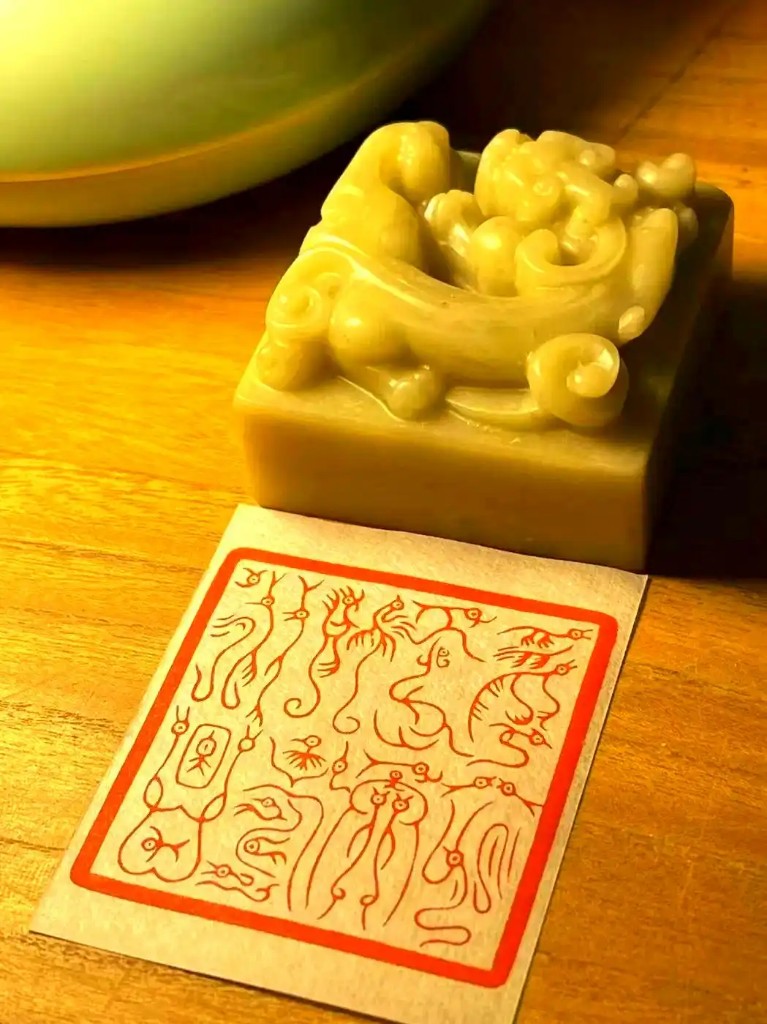
A traditional Chinese name seal (名章) rendered in seal script (篆书).
Why Seals, Not Signatures?
Seals have been used in China to sign documents for more than two millennia. Historically, a carved or cast matrix made an inscription repeatable: the same name, title, studio, or saying could be impressed again in a recognizable form.
That repeatability does not make a seal impossible to copy or forge. A seal impression is one piece of contextual evidence; responsible authentication also considers the object, inscription, documented examples, and provenance.
What Symbolic Weight Does a Seal Carry?
The inscription and setting determine what a seal communicates. A title on an administrative document, an artist's name beside a signature, and a studio name on a painting do not carry the same function simply because all appear in red.
How Do Seals Function as the Painter's Claim in Art?
Walk through a museum gallery of Chinese painting and you may see small red impressions beside a signature or around the margins. The Met notes that artists use seals both to sign works and to balance a composition with a touch of red.
Older paintings may also carry seals added by later collectors as marks of ownership. Those impressions can help researchers study an object's history, but attribution still depends on more than the presence of a familiar seal.
How Do Seals Create a Chain of Cultural Custody?
In this context, a seal is a visible record of participation: an artist, studio, collector, or appreciator chose to place a mark on the work. Its evidentiary value depends on whether the inscription and ownership history can be independently supported.
What Are the Red Stamps You See on Chinese Art?
An artist may use a proper name, sobriquet, or studio seal; a collector may add an ownership mark later. Museum catalog records often distinguish these roles rather than treating every impression as an artist's signature. Read together with inscriptions and ownership records, the marks can help reconstruct provenance. Read alone, they cannot verify a complete chain of custody.
How Do You Identify a Chinese Artist's Seal?
First identify the kind of task. Reading asks what the inscription says and whether the impression is in relief or intaglio. Attribution asks who used that inscription. Authentication asks whether the object or artwork is what it claims to be. The first task can inform the others, but it cannot settle them by itself.
When Did Seal Carving Become a Literati Art?
The Met dates an important change to the late sixteenth century, when artists increasingly adopted soft stones, or soapstones, and seal carving became an important branch of Chinese literati art. Softer material made it practical for a calligrapher or artist to participate more directly in carving rather than relying only on hard materials cast or worked by specialists.
The museum's pair of Shoushan soapstone seals illustrates the later esteem for stones from Fujian and Zhejiang. This evidence supports a Ming-period literati turning point; it does not support identifying a supposedly Song seal from size, patina, or a few stylistic adjectives.
How Did Seal Script Enter the Tradition?
Seal script is not a modern typeface or one fixed set of decorative shapes. It refers to archaic writing traditions that developed over long periods. The Met's Inscriptions on the Stone Drums describes a transition from large-seal forms toward the standardized small-seal script used in Qin official documents.
Later seal carvers drew on archaic forms while adapting them to a small carved surface. That is why reading a seal responsibly requires attention to the exact character source rather than assuming any old-looking glyph is correct.
Can You Authenticate an Antique Seal Online?
Not from a generic checklist or a single photograph. Museum object records separate material, dimensions, inscriptions, provenance, references, and curatorial notes because these are different kinds of evidence. A convincing impression, old-looking patina, or irregular tool mark is not enough on its own to establish date or authorship.
For a valuable or supposedly antique object, consult a qualified specialist who can examine the seal itself and its documentation. For an ordinary modern name seal, the more useful questions are simpler: Are the characters correct? Is the reading order clear? Is the impression described honestly? Does the design preserve the name the user approved?
How Do You Read a Chinese Seal?
Many square name seals arrange vertical columns from right to left, but historical layouts vary. In MingShu's default four-character layout, the reading order is top-right, bottom-right, top-left, then bottom-left. Because seal-script forms can differ sharply from modern regular script, confirm the inscription against a trusted character source rather than guessing from appearance.
What Materials Are Used to Craft a Chinese Seal?
Chinese seals have been cast in metal or carved from stone and other materials. From the late sixteenth century, soft stones became especially important to literati seal carving because artists could work their calligraphic ideas directly into the seal face. Shoushan and Qingtian are among the well-known stone traditions documented in museum collections.
What Are the Main Types of Chinese Seals?
Chinese seal tradition recognizes several categories, each with its own cultural function:
| Type | Pinyin (Chinese) | Function |
|---|---|---|
| Name Seal | Míng Zhāng (名章) | Personal identification — your name carved in seal script |
| Studio Seal | Zhāi Hào Zhāng (斋号章) | Your artistic or literary pseudonym |
| Leisure Seal | Xián Zhāng (闲章) | A personal motto, poem, or philosophical statement |
| Official Seal | Guān Yìn (官印) | A title or office used under the rules of the issuing institution |
A Name Seal (名章) is a familiar personal category. MingShu creates a digital name-seal design in a square vermilion composition, using only typefaces and character forms exposed by its reviewed font registry. That differs from commissioning a carver to cut a physical stone matrix.
How do you make a personal Chinese name seal today?
The practical path keeps culture and product separate: understand what a seal means, then confirm the exact characters before you seal them.
- Confirm your Chinese name — use the name you already have, or follow the structure of a Chinese name and the guided naming path if you still need one.
- Preview the inscription — in the Chinese Seal Maker, approve the Simplified or Traditional form, typeface, and red (朱文) or white (白文) impression on a free on-page preview.
- Unlock private delivery — when the design is right, the $5 Seal Identity Pack opens your private name scroll, approved seal PNGs, and the rest of MingShu's identity delivery.
This is the same flow whether you call it a seal, stamp, or chop: the value is in the confirmed characters and an honest preview—not in treating a decorative image as an official credential.
Integrating BaZi Analysis with Name Seal Creation?
Some naming traditions use BaZi and Wu Xing as symbolic frameworks for discussing a person’s birth information, character associations, and desired qualities. MingShu makes that reasoning visible so the user can evaluate it rather than presenting it as fate, prediction, or a guaranteed effect. The process begins with understanding the structure of a Chinese name, then confirming the exact characters before designing the seal.
The seal gives that confirmed name a visual and material form. Its value comes from the user’s informed choice, the cultural reasoning behind the characters, and the quality of the design — not from claims of supernatural power.
Why Does Seal Script Look Different from Modern Chinese?
Seal script (篆书, Zhuànshū) refers to archaic writing forms rather than one modern font. The forms developed across early inscriptions and were later standardized and reinterpreted; their structures can look unfamiliar beside modern regular script.
For a contemporary name seal, historical appearance cannot come at the expense of character identity. A responsible design uses a documented glyph, preserves the confirmed Simplified or Traditional form, and fails visibly when a character is not covered instead of inventing a plausible-looking substitute.
How Are Seals Used in Modern China?
Chinese seals remain culturally relevant, while authorized organizational seals and reliable electronic signatures also have defined roles in contemporary administration and commerce. China’s Electronic Signature Law sets specific conditions for a reliable electronic signature. That legal framework does not turn a downloaded personal seal image into a credential, registered organizational seal, or verified electronic signature.
Why Does Owning a Seal Signal Cultural Refinement?
Owning a seal — especially one carved by a skilled artisan — can express care for calligraphy, material craft, and personal presentation. A seal impression paired with handwriting can create a distinctive visual identity without implying official authority.
What Does a Digital Seal Mean for Your Identity?
The MingShu Chinese Seal Maker turns a confirmed Chinese name into a configurable digital name seal. You approve the exact characters, Simplified or Traditional form, typeface, inscription, and red or white impression before obtaining the final files. The result follows Chinese name-seal conventions without claiming to be a hand-carved stone matrix.
The result is a cultural and visual artifact: it can mark creative work, stationery, a profile, or a personal identity pack. It does not verify identity, sign a contract, or replace an authorized physical or cryptographic seal.
In digital settings, artists may use a custom seal as a visual signature or watermark, while language learners and other users may place one on journals, stationery, or social profiles. A generator makes those uses accessible, but cultural credibility still depends on choosing the characters carefully and describing the result honestly.
Cross-Cultural Applications: Foreigners Using Chinese Seals?
Artists, language learners, calligraphy enthusiasts, and other users outside China may place personal seals on journals, creative work, stationery, or profile images. Respect begins with understanding what the inscription says and avoiding claims that a decorative personal seal grants official status or cultural authority.
Chinese Seal Culture in Modern Branding and Digital Applications?
A custom seal can serve as a compact visual identifier in personal stationery, photography, illustration, packaging, or a broader brand system. The design should be presented as a contemporary use inspired by seal culture, with accurate characters and a clear distinction from an authorized official seal.
The modern Chinese seal generator has made this tradition more accessible. A user can bring a carefully chosen Chinese name into the Seal Maker, review its exact inscription and visual treatment, and obtain files for creative or personal use. When the characters and their cultural reasoning are clear, the resulting seal can communicate a considered identity in a compact visual form.
This contemporary use shows how a historical form can enter new media without pretending that every digital impression has the function of a carved or institutionally authorized seal. A well-designed personal seal is valuable because its inscription is understood, chosen, and represented accurately.
What are the red stamps you see on Chinese paintings and calligraphy?
Those red marks are Chinese seals (印章). On a single artwork you may see an artist's seal, studio or name seals, and collector's or appreciator's seals added at different times. Together with inscriptions, catalogs, and ownership records, they can help scholars reconstruct provenance. They are historical clues, not a self-verifying chain of custody.
Which Sources Support This Guide?
This guide uses museum and official sources for the claims that carry the most weight:
- The Metropolitan Museum of Art: Xie Zhiliu and the Art of Seal Carving — document signing, inscription types, relief and intaglio impressions, artist and collector uses, and seal materials.
- The Metropolitan Museum of Art: Pair of Square Seals with Cloud and Rock Pattern — the late-sixteenth-century rise of soft-stone literati seal carving.
- The Metropolitan Museum of Art: Inscriptions on the Stone Drums — the development of large-seal and standardized small-seal script.
- China's Electronic Signature Law — the conditions for a reliable electronic signature and why a downloaded seal image is not automatically one.
Continue Reading
MingShu (名书): What It Is & How Chinese Names Are Crafted
How MingShu creates your name, poem, visual art, and seal — the full identity package.
Read moreYour Name Is Your First Cultural Passport
Why a Chinese name is an act of identity, not just a label.
Read moreProfessional Chinese Naming Service: BaZi, Five Elements & Classical Literature
Name, seal, poem, and visual art — the complete identity package crafted by a naming service.
Read moreReady to make your personal Chinese name seal?
Confirm your Chinese characters, preview the seal design for free, then unlock your private name scroll and seal PNGs with the $5 Seal Identity Pack.
Create Your Chinese Seal →