Your Name Is Your First Cultural Passport
In the West, a name distinguishes you from others. In China, a name defines what you aspire to become.
When you meet someone new in London or New York and they say "I'm John," you register the sound, maybe associate it with other Johns you know, and move on. The name is a label — a way to distinguish this person from the next.
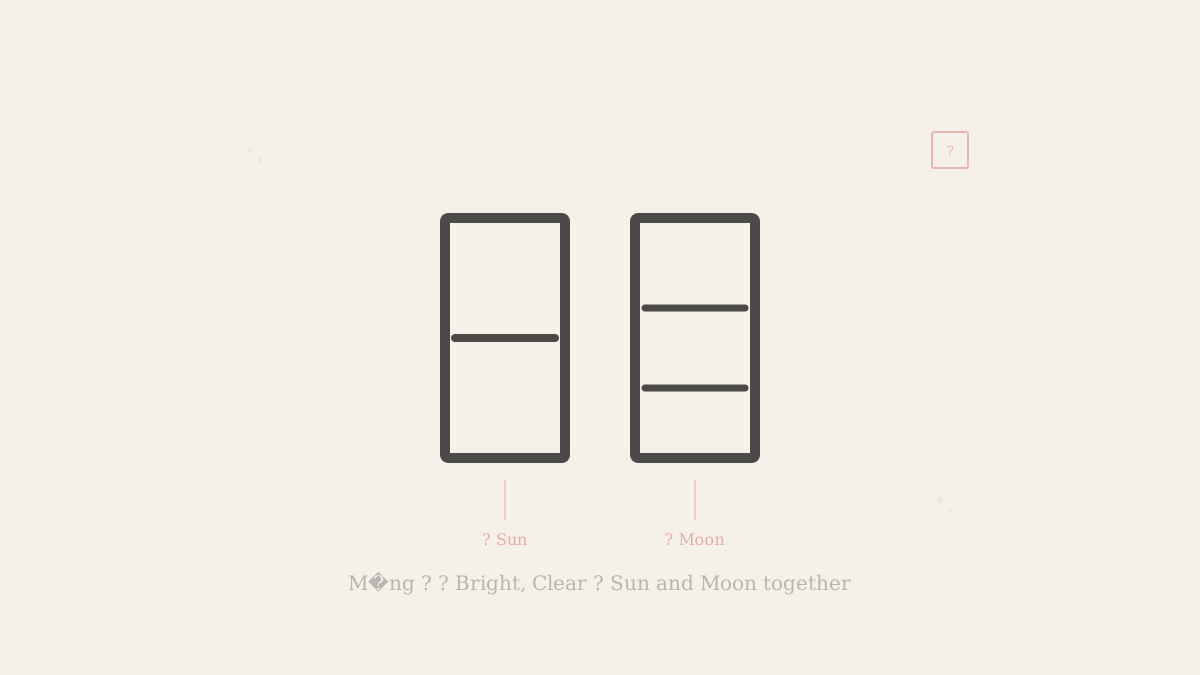
When you meet someone in Beijing and they say "我叫明远 (Wǒ jiào Míng Yuǎn)," the name is immediately read as a text. 明 (míng) means "bright" or "clear." 远 (yuǎn) means "far" or "visionary." The name does not just identify — it characterizes. It tells you that this person's parents wished for them to be someone of clarity and long vision. This tradition of meaningful given names dates back millennia.
This is the fundamental difference between Western and Chinese naming traditions: in the West, a name points to who you are; in China, a name points to who you could become.
How Is a Chinese Name a Wish?
In Chinese culture, naming a child is one of the most important acts a parent performs. It is not unusual for a family to spend weeks — sometimes months — deliberating. Grandparents are consulted. BaZi charts are analyzed. Classical texts are searched for characters with the right combination of sound, form, meaning, and elemental balance.
Why Is Choosing Characters Treated as a Solemn Act?
The reason for this care is that the name is understood as a wish made solid. Every time the child's name is spoken — by a teacher, a friend, a colleague — the wish is renewed. The character 慧 (huì, "wisdom") in a name is not just a description; it is an aspiration spoken aloud a thousand times. Over a lifetime, the name becomes a quiet compass, orienting the person toward the values it embodies.
Why Do Chinese Characters Carry So Much Weight?
Consider how differently English names and Chinese names carry meaning. "Oliver" derives from the Latin olivarius ("olive tree"), but almost no English speaker thinks of olive trees when they hear the name. The etymological meaning has evaporated through centuries of use.
How Do Logographic Characters Keep Meaning Alive?
Chinese names do not evaporate. Because Chinese is a logographic language — each character is a picture, not a sequence of abstract letters — the meaning remains visually and conceptually present every time the name is written or read. When a Chinese person sees the character 雪 (xuě, "snow") in a name, they see snow. When they see 龙 (lóng, "dragon"), they see power. The name is never just a sound — it is a perpetual image.
This is why choosing a Chinese name is such a profound act. You are not just choosing a label. You are choosing the images and values that will follow you through every interaction in the Chinese-speaking world.
How Does a Name Become a Cultural Passport?
For foreigners engaging with Chinese culture — a dynamic explored extensively by the Asia Society's education resources — a name functions as a cultural passport. It communicates, before you speak a single sentence, whether you have done the work of understanding the culture — or whether you are passing through.
What Does an Authentic Name Signal?
A transliterated name like 迈克尔 (Mài Kè Ěr, "Michael") says: I am a visitor. An authentic name like 陈文远 (Chén Wén Yuǎn) says: I respect this tradition enough to carry a name with real weight.
This distinction is not about judgment — Chinese people are generally welcoming of any effort to engage with their culture. But the difference in response is tangible. An authentic name opens doors that a transliteration cannot. It transforms introductions from polite exchanges into genuine connections. It turns "Lao Wai" (Foreigner) into "Peng You" (Friend).
How Do You Choose the Values Your Name Carries?
When you choose a Chinese name — or when MingShu crafts one for you — you are making a values declaration. You are selecting the qualities you wish to embody in this cultural context: clarity (明), perseverance (坚), grace (雅), depth (涵).
This is not vanity. It is intentional identity design. In a world where identity is increasingly fluid and self-directed, choosing a name that encodes your values is one of the most grounding acts available — especially when that name is rooted in a tradition thousands of years deep.
Why Is a Name Both the First and Last Thing?
In any culture, your name is the first thing people learn about you and the last thing they remember. In Chinese culture, that first impression carries extraordinary weight because the name is legible — its meaning, its aspirations, its elemental balance can all be read at a glance.
This is why getting a Chinese name right matters. It is not a trivial decision or a fun souvenir. It is the foundation of your cultural identity in the Chinese-speaking world — your first passport, your first handshake, your first act of belonging.
"In English, a name is a sound. In Chinese, a name is a sentence — one that people will read every time they meet you."
Continue Reading
MingShu (名书): What It Is & How Chinese Names Are Crafted
What MingShu means and how it creates culturally grounded Chinese names.
Read moreThe "Lao Wai" Effect: How Your Name Changes Everything in China
The social dynamics that change when you carry an authentic Chinese name.
Read moreWhat Makes a Chinese Name Authentic (and Why Most Aren't)
The difference between an authentic name that opens doors and a transliteration that signals tourist.
Read moreTurn your Chinese name into a seal you can keep.
Use the Chinese name you already have—or discover one in the guided flow. Approve your free preview, then open your private name scroll with the $5 Seal Identity Pack.
Create Your Chinese Seal →